
 We’ve all had those magical moments of looking up and suddenly seeing something breathtaking in the sky. Perhaps it was just a moon low in the sky with a planet near and bright. Perhaps it was the Milky Way pouring itself into the horizon over a country road. Whatever the source of wonder, our ability to see and appreciate the sky is directly related to the darkness. To a city dweller, Venus is particularly stunning because often it appears as the only “star.” In the country, however, Venus is just one bright object against a sea of flickering spots, and it the Milky Way that amazes on nights without the moon.
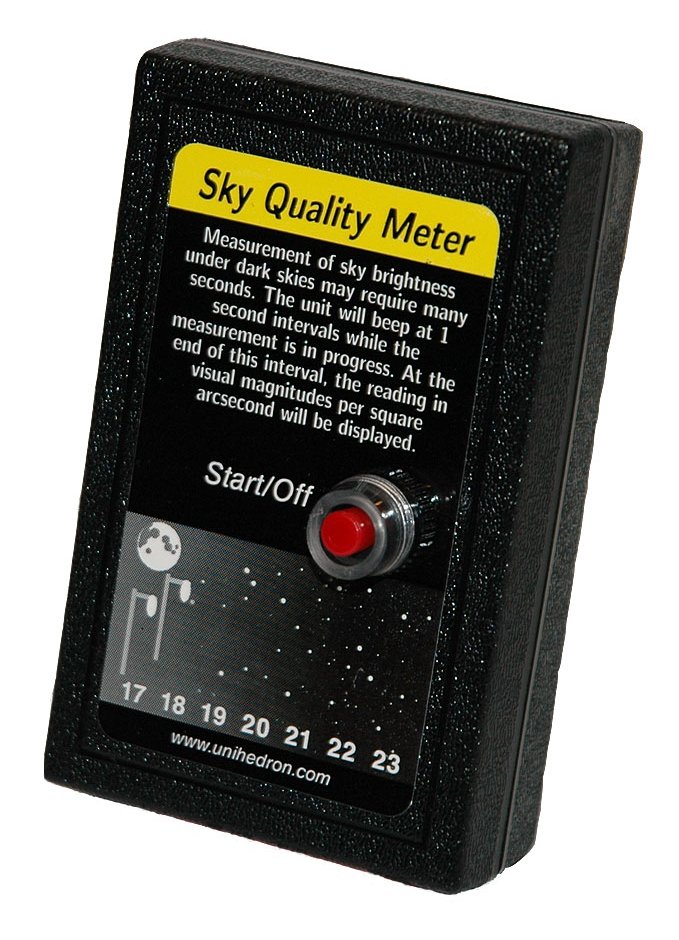 Different people have been looking for different ways to quantify how dark various skies actually are. One of the most straight-forward techniques is to look up and see how many stars appear in known constellations. This technique was employed by the globe at night to get kids to collect data on light pollution all around the globe. This works, but it relies on people, who tend to make subjective decisions. To replace people, Doug Welch and Anthony Tekatch have developed a Sky Quality Meter that directly measures how much light is coming from the sky.
This little meter has a bunch of different possible uses. I bring this up because I have a brand spanking new one in my greedy little hands. I’m going to give it away at a talk I’m giving Sunday in Greensboro after sharing these neat uses with my audience. I’ll give you guys a sneak peak of what I’m going to talk about.
- What does the moon do to the sky? We often talk about the effects of moonlight on our ability to observe (for instance, tonight I played the ‘guess the constellation given 1 star’ game at a star party thanks to the gibbous moon). Now we can document the moons light polluting ways! Consider making a night sky observation every night 2 hours after dark (prime backyard observing time) and tracking how the moon lights the night.
- Are the clouds bright or dark? Growing up in the northeast, I learned that night time clouds are bright and either amber or raspberry in color. The cloudier it got, the brighter the sky. While observing at McDonald Observatory in West Texas, I learned that it is only so dark you can’t see your hand in front of your face on a cloudy night away from light pollution. In West Texas, the clouds were actually the dark patches in the sky. With a light meter, it is possible to measure how much light the clouds reflect back to Earth and assess light pollution. Consider testing one on a cloudy night when the moon is set in a bedroom community, and then sending it to a friend in a remote location and asking them to make a cloudy sky measurement on a similarly dark and stormy night.
- When the malls shut down, the stars turn on! During long winter nights, it is possible to document when people go to bed by looking at the night sky. Specifically, as malls close (and turn off their signs), as people go to bed (and turn off their lights), and as cars settle into garages for the night (with their headlights off), the sky gets darker. On a night with no moon, try taking measurements every 20 minutes. Perhaps rush hour will show up as a brightening, and the end of the nightly news will mark a darkening.
- Battle of the arena lights! Local sporting arenas often create glows on the horizon during nighttime events – which can include sports and band practices. Try measuring the sky brightness during when arena lights are on from your school or clubs observing site, and under identical moon conditions take a new measurement when the arena lights are off. Use this data to talk to people about how many stars disappear when the arena is lit, and use this as a starting point in a discussion to limit night time practices. (plus – kids should get to go home in the evenings at least occasionally.)
And Lastly… You can use it on your neighbors.
So I have neighbors. The ones immediately to the left and right of our house are great. A few of the others whom I’ve met (but can’t necessarily match to their house when I see them at the store) have all been very sweet. Many of them have offered to even loan us their lawn mowers, many times, with somewhat hopeful looks. All that aside, there is one neighbor I don’t know personally, but whose house causes me an emotional “grrrrrrr” reaction every time I see it. During a recent round of renovations they managed to turn a historic yellow and pale blue Queen Anne Victorian into a McMansion Victorian. It was kind of impressive, in a depressive kind of way. To show off their display of boring, cookie cutter, grey with white shutters, idea of taste, they have set up all sorts of illumination: side walk lights, house lighting up lights, light lights, etc. YUCK! So, not being one to have patience for McMansions, I’m considering using a Sky Quality Meter to document the effect they are having on the sky.









The clear dark sky clock has a link to a light pollution map for any of the locations given. On that page, there are descriptions of the different levels of light pollution.
http://cleardarksky.com/lp/LkErMtPkMIlp.html?Mn=science
Worst says things like “Entire sky is grayish or brighter. Familliar constellations are missing stars.”. That’s where i live. I can find a dropped contact lens without a flashlight.
Best says things like “Rising milky way confuses some into thinking it’s dawn.”
I recently did some observing in Upper Michigan. Mag 6.5 or so skies. In my 10″ scope, m31 wasn’t just the core. It didn’t fit in a field of view. The arms stretched out a field or so in both directions. m32 and m110 weren’t hard to spot fuzz balls. They showed detail. Very cool.
Mostly, i count stars in the little dipper. But for more precision, the sky clock descriptions rock.