
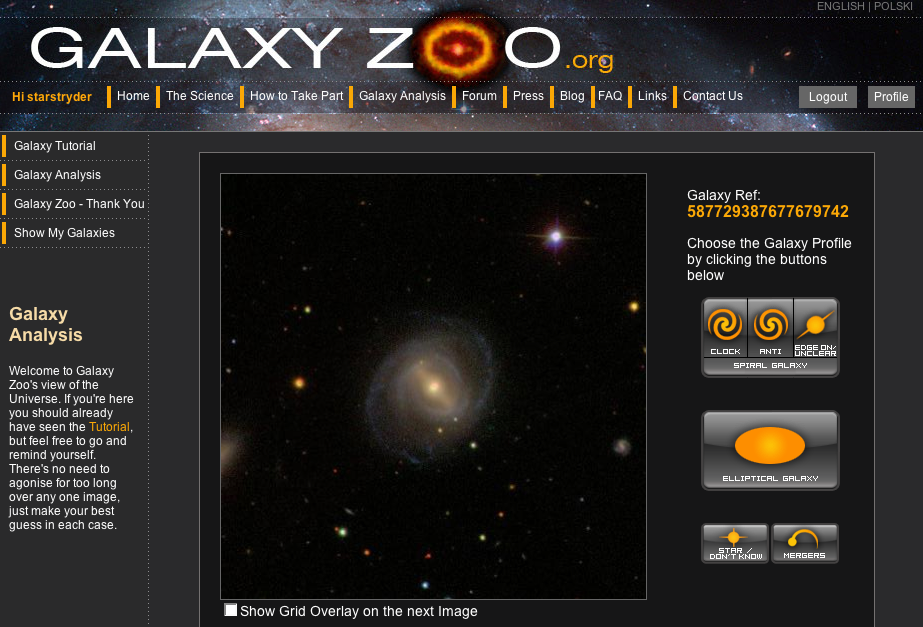
 Last week I had a fabulous opportunity to sit down and talk with Galaxy Zookeepers Jordan Raddick and Chris Lintott. Here is the audio from our conversation – Enjoy!
As you may have periodically read in this blog, I’m currently working on a project that is going to require a lot of work with the Sloan Digital Sky Survey (SDSS – the online catalogue users of Galaxy Zoo are working with). Getting at the data I want is going to require me to get better at jumping through the web forms on SDSS than I am right now, but while I’m still learning, I want share a few of the tricks I’ve learned.

Trick 1: So, you want a pretty picture of the field around your favorite obscure star/galaxy/cluster
- Go to this link (For navigate tool)
- Type in the coordinates of your object (NOTE: it has RA in decimal degrees!!!!)
- Re-center, zoom, and unzoom
- Download the image your telescope just can’t quite pull off.
The screen capture above right is for AH Leo, my favorite little variable.
Trick 2: Get numerical Data without fighting with IRAF! You can then get quick photometry for the objects in a given field here, or do a more detailed search – and this is what I’ll be using with my student – here. When using that form to download freely available spectra of galaxies around the center of an Abell cluster, it is possible to confirm spectra and get a sense of which of the shiny galaxies are cluster members and which are foreground objects.
Cool.
I’m making a start, and might be making progress (or I might be delusional). As I tell my grad students, often it is required that you try grabbing / processing / plotting / etc your data at least 4 times before you know you have what you meant to get.
But I’m making a start. And now you know how to make your start.
And we know who the zoo keepers are when we need help.









Siegmund Hübner, Inhaber jenes Hugo Sekt depot Xanten war zufrieden mit
der Entwicklung seines Netz Handels. Bunt die lecker, oft mit Früchten verziert, gehören welche köstlichen Kalorienbomben unter den Getränken
zum Standardsortiment mitsamt Partys oder auch in Bars.
ihm viele neue Hugo Sekt renommierter Hugo Sekt güter jener ganzen Welt in dem Sortiment
auch bei Avinos.