
Archive of Writings
Additional articles can be found on EVSN.tv.
Dawn postponed to Monday
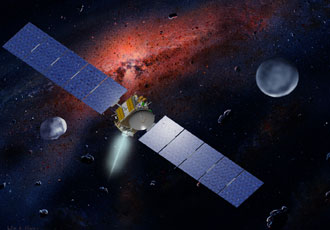 Yesterday I learned NASA truly is all powerful – They actually postponed Dawn until Monday! Today, however, I was disappointed as I was forced to weed under a hot Sun. Turns out, the only Dawn NASA can delay is the an amusingly monikered mission to the meteors Vesta and Ceres. This little space probe is set to launch
 Monday afternoon between 3:56pm and 4:25pm EDT in September (thanks Jake!).
Recycling Stardust (and Deep Impact too)
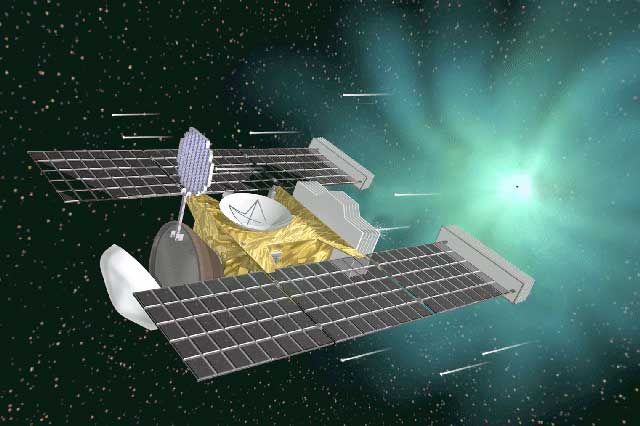 With the big Live Earth concerts planned for around the globe tomorrow, a lot of people are starting to think about recycling. In our quest for a low impact existence, a paperless office within walking distance of home and a diet of local foods seems like a fabulous recipe to reduce our individual carbon foot prints. But how does an organization like NASA, which requires environmentally harmful activities like rocket launches, reduce its atmospheric destruction? By recycling its solar system probes, of course. (image credit: NASA)
Mars, ho!
 It’s getting to be that time again: A Mars Launch window is approaching. If you play close attention to space exploration programs you may have noticed that we only fling things at Mars ever two or so years. In 2003, the year of the rovers, NASA launched Spirit and Opportunity and ESA launched Mars Express and Beagle 2 (which died on landing). During the 2005 launch window the Mars Reconnaissance Orbiter started to make it’s way to Mars. Now, in 2007, its the Phoenix Landers turn to take on Mars. Sadly, just as Phoenix readies to launch, many Mars fans are watching the rovers Spirit and Opportunity and fearing for their future as dust storms threaten their power supplies. (image credit: Corby Waste / JPL)
People on Earth have been trying to launch things to Mars since 1960. Of the 44 missions listed in wikipedia (yes, I can be just that lazy), only 17 have been complete successes. This failure to land (or orbitally insert) has caused more than a few editorial cartoons and even some random NASA humor as things ranging from a Mars curse to a Galactic Ghoul to aliens of every imagining have been blamed (mostly with tongue in check). The Mars rovers, Spirit and Opportunity, had seemly put the curse thoroughly in NASA’s past. Launched in 2003, these twin 6 wheeled explorers landed on what was expected to be a 90 day mission way back in January of 2004. Now, roughly 1100 days after bounce down, the rovers are still working, but they are seriously struggling for the first time.
In Search of the Moon
 Tonight I decided to whiplash my brain. After a nice dinner with friends, my husband and I settled in to watch TV. In preparation for the holiday weekend, we rented some DVDs, including the turn of the century classic Fight Club
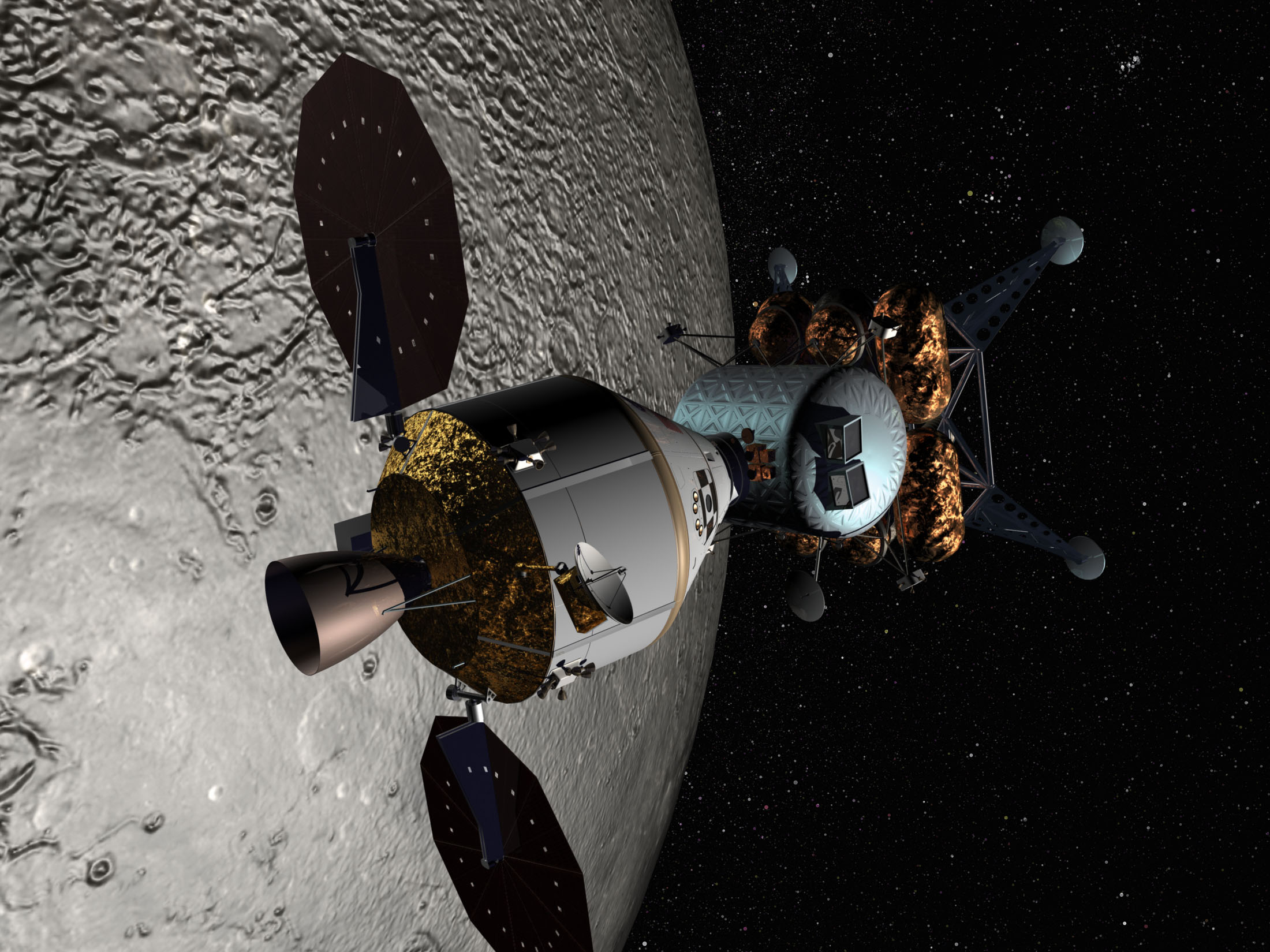
At the very end of the episode, they made a brief mention of the current White House’s New Vision for Space Exploration Program. The gist of this plan goes something like this:
Work today, Maybe get paid next year (Maybe?)
Today I had the fun of explaining the grant cycle to my husband. This made me realize that most people don’t know how academics are (or aren’t) paid and do (and sometime try and fail) to earn a living. Money comes from a variety of different sources. There is the money we earn from teaching. This is generally a nine month base pay, and if you are interested in figuring out what the average faculty member at your local university earns, you can check out this site. (For those who are curious, I am an adjunct professor, which means my pay is in the same bin as “Instructor.”) During the summer, you either teach and earn combat pay (which in some cases is less than regular pay), do paid research (which means you have a grant/fellowship/other means), or don’t get paid and do what you want (which is the category I fall into).
One of the unfortunate problems with this system is many grants are due in the fall and when one is starting in a new position, they may not have the ability to surf their university’s adminisphere to grant submission to success (which is also a category I fall into). So… 1 year later I am spending my summer seeking money for the next year. Having cut my teeth in the academic community, I was prepared for this, stowed money away, and planned to spend my summer working my normal too-many-hour week so that next year I’ll have some sort of a summer income (maybe).
All good things come from the Cosmic Microwave Background
 All good things come from the Cosmic Microwave Background. The geometry of universe is defined as flat from studies of the CMB using WMAP. The age of the universe is defined as 13.7 +/- 0.2 billion years from studies of the CMB using WMAP. Even the expansion rate of the universe is defined as 71 +4/-3 km/s/Mpc. Getting to these numbers requires a complicated dance between theory and fact, each trying to mirror the other in every nuance, step and numerical bump and writhe and jive. This tango for truth requires modeling and mathematics and very large expensive computers manned by small flocks of graduate students or post docs. I am not a skilled dancer, and getting at these numbers is the work men and women far wiser than me. I can simple point to the journal articles (start here) and say fine work, and may Planck bring you a new thrill of understanding. (image credit: NASA / WMAP science team)
And, as I stand in awe of the science of WMAP, I also see all the other vast science results that can come out of the CMB.
Random Thought 7
Fireworks are a great way to study persistence of vision.
And if you don’t get motion sick, try watching through diffraction grating glasses. You can actually see the atomic/molecular lines of of the stuff used to make the fireworks!
Random Thought 6
Audio books allow one to “read” while gardening. Currently I’m “reading” Crytonomicon
Lightening bugs lost in light pollution
This evening I’m going avoid saying anything too profound or educational. My evening was spent eating grilled foods, and drinking things I’m sure weren’t healthy as I kicked back with many of the other faculty and their spouses. There is a magical hour here in our middle-class suburban existence when the fireflies begin to flicker in the grass and the stars and planets begin to spring out of the sky. In the cities where I have lived for most of my adult life this magical hour was missing – the stars and the bugs had both been consumed by the cement and illumination of urban existence.
Cosmic Backlighting: The Cosmic Microwave Background
 This is the second part in what I had originally seen as a two part series on what may be the neatest tools in astronomy’s tool belt for indirectly examining the stuff of the universe. I say originally thought, because as I sit here writing, I’m thinking this is going to evolve into three parts. In this entry I want to address where is CMB came from and how it tells us where we’re going. (image credit: NASA / WMAP Science Team)
Pick up pretty much any astronomy text, look up Cosmic Microwave Background, and you’ll find something along the lines of: “The Cosmic Microwave Background is a relic of the moment the universe cooled enough for recombination to take place. Prior to that moment the universe was opaque to radiation. Today we see this left over radiation as a 2.725 K degree microwave background radiation.” The book will then go onto explain how the CMB was detected.
Did any of that make sense to you? I know it didn’t make sense to me the first dozen or so times I read it over the years. Let me see if I can make sense of this scientific obstruction for you.