
Archive of Writings
Additional articles can be found on EVSN.tv.
Finding Hints of the Higgs Boson in the Blogisphere
A few days ago I got an email asking if I knew anything about rumors circulating about folks using the Tevatron at Fermi National Accelerator Laboratory finally discovering the Higgs Boson – the boson responsible for giving particles the characteristic of mass. I have to admit, I didn’t, so I just did a bit of Googling.
While I didn’t find a nice peer reviewed paper pointing to Higgs, what I did find was a New Scientist article on how hints of positive detection were first noted on one blog, and then independently seen when the research was publicly released on another blog.
Space Shuttle Atlantis Launched!
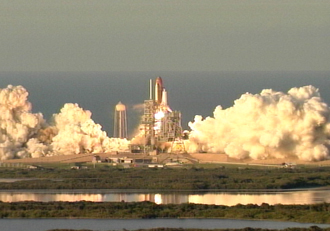 The space shuttle Atlantis successfully launched into clear blue skies this evening. Although the external tank looked a bit diseased (thanks to the patch job that had to be done to after a hail storm), it was still a picture perfect launch. For full NASA coverage, check out the STS-117 mission page.
Random News
The following unattached thoughts are listed here in no particular order:
- A big woohoo to my Astronomy Cast co-host Fraser Cain for his appearance on the Wired Blog Network. Fraser’s Universe Today is a must read for anyone interested in astronomy.
- Next week, on June 14th, the Space Carnival will be hosted by yours truly. Please send submissions to CarnivalOfSpace@gmail.com by 6pm June 13th. Any blog can contribute, however contributions need to be related to, well, space. To learn more check out This site and links therein.
- If you are an educator, check out this neat program planned to kick off the launch of the next Mars exploration program: Phoenix.
Okay, randomness over.
The Universe: The Red Planet
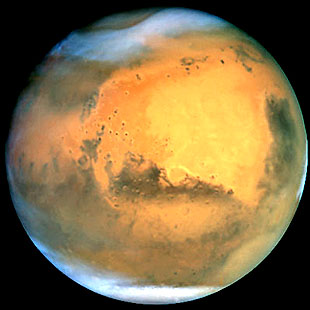 I just finished watching this week’s episode of “The Universe.” As its name, The Red Planet, implies, this episode focused on the forth planet from the Sun: Mars. It took a systematic journey through our understanding of Mars that included historical perspectives and modern space based explorations.
One of the things it particularly emphasized (that I don’t think is generally talked about enough) is the importance of a magnetic field in maintaining a planetary atmosphere.
The Earth, which still has its atmosphere, is significantly larger than Mars, and we are still cooling off as a planet. Once upon a time, our world was so hot that volcanoes were going off all around the globe, and the material they threw into the atmosphere settled into a noticeable layer of soot. Today, our world is a bit calmer, a bit cooler, and a bit less messy. Given enough time, volcanism may die out altogether as our planet cools and its liquid iron core solidifies. When that happens, our planet’s magnetic field will also die down and the magnetosphere will disappear.
To get a picture of what this means, we need only look one world out.
The Quiet Desperation of Relying on Old Tech
Several minutes ago I asked my beloved laptop to please
> tar -cvf AAS.tar Interviews
It said
/Interviews
and it began to tar.
That was several minutes ago.
It is still going.
I have a no longer shiny, no longer able to latch shut, sometimes failing to wake, but still much beloved Apple PowerBook G4 (1.67 GHz, 512MB). I bought in the days when I always owned what was new and hip and tech trendy. I bought it when my RAZR was something to be awed over and when my 20GB iPod was still the newest on the block.
That was before I left Harvard and got a job at a small state college.
I still have that RAZR. It now determinedly states, “You have text messages” with a silly little message that never goes away, no matter how many times I check and delete all my text messages.
I still have that iPod. It now protests being asked to share long afternoons together by randomly freezing up and refusing to respond until its batteries have fully discharged and been recharged.
I feel like I’m trapped in 2005, and as I look at the rumors of the iPhone and of new iPods and of Leopard, I feel this quiet desperation building inside.
Most Massive Star Ever Weighed
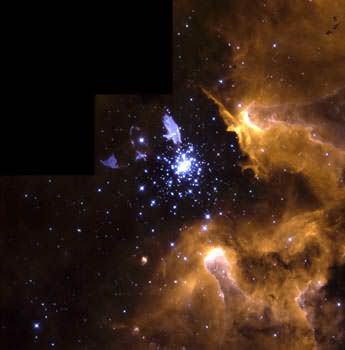 The only time astronomers can determine stellar or planetary masses with any certainty is when the stars or planets occur in systems that are aligned such that we can measure both their velocities using spectra, and we can observe the objects eclipsing one another. Today, a team of astronomers lead by Anthony Moffat (Universite de Montreal) announced they had found the most massive star ever identified. Weighing in at 114 Solar Masses, it is roughly 30 solar masses larger than any previously identified star, and it shares a binary star system with an 84 solar mass star. Looking at these two super luminous stars with their Wolf-Rayet like emissions, astronomers are looking at the site of what may become a black hole – black hole binary system. Maybe.
Deja Press Release: More on Black Hole Spin
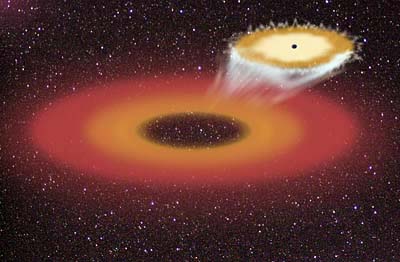 Last week at the AAS there was a press conference focused on how super massive black holes interact during galaxy mergers and why/how black holes aren’t ejected during mergers. That press conference highlighted the work of University of Maryland researchers lead by Chris Reynolds that took into careful account the spin of the black holes and the angles between the merging black holes’ axes of rotation. Observational data mining by University of Texas researchers lead by Greg Shields was also discussed.
Today I got a press release that started, “Scientists have discovered for the first time just how fast a supermassive black hole can be thrown from a galaxy when it merges with another black hole. The crucial factor in producing large “kicks” turns out to be the spin that the black holes carry prior to the merger.
Politics, Religion, Science and Tears
There are few concepts that can make advocates of the scientific method, astronomy and biology more twitchy than “Creationism.” In its strictest sense, creationism is the belief that humanity, life, the Earth, and the universe were created in their entirety by a supernatural deity or deities (typically God), whose existence is presupposed.* This definition is extremely broad and leaves room for both Descartes’ watchmaker Deity – a God who sets the universe in motion and watches it tick – and a literalist view of the Bible that implies a young Earth – e.g. the view that the Bible tells the factual Judeo-Christian History of the actual creation of the Earth. In today’s rhetoric, it is generally the later form of Creationism that is meant when the word is used. For instance, the Discovery Institute and the Creation Museum both use the word Creationism to describe a cosmology in which dinosaurs and man co-roamed an Earth that was created several thousand years ago.
Let me start by saying I hate vague language (even if I sometimes fall prey to using it).
Republicans and Creationism
There is a story over on Cosmic Variance that is a most read for anyone planning to vote or to try and influence someone’s vote in the U.S. 2008 presidential elections. To quote Sean: “It was an embarrassing moment in the first Republican presidential debate when the participants were asked, “Does anyone not believe in evolution?”, and three candidates — Sam Brownback, Tom Tancredo, and Mike Huckabee — raised their hands. Embarrassing for those three, obviously, but also for the Republican party, in which they are far from unrepresentative, and for the United States, that anyone would even think to ask such a question of serious candidates for the highest office in the land.” (Read entire story here)
In search of Tidal Tails…
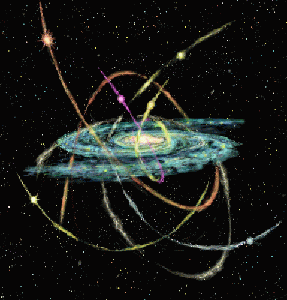 Okay, at this point it is old news, but, just to state the old news one more time for anyone who missed it – our galaxy has tidal tails.
The first press release on tidal tails that I know of occurred at the 2001 San Diego meeting of the AAS, and was related to work announced by Heather Morrison (Case Western Reserve University) describing the stream created when the Sagittarius Dwarf Galaxy fell into and was shredded by the Milky Way.
Since then, there have been memorable releases at AAS Seattle in 2003, AAS DC in 2005, AAS Seattle in 2007 and at last week’s AAS in Honolulu. There may have been other releases, but those I’ve forgotten.
That’s a lot of releases for one small topic, and while I have started to giggle a bit when I see a new tidal stream in my packet of press releases, I don’t think the press releases have been without merit. Understanding these sprawling families of stars helps us understand the history of our Milky Way. The Milky Way was formed through the merger of dwarf galaxies, and these mergers left (and continue to leave) beind streams of stars. In theory, as galaxies merge together, they are elongated as they are shredded within gravitational potential wells. Observing tidal streams and tidal tails provides checks on our theories (and in a wispy, mist-in-a-breeze kind of way, they are also beautiful).
And the way they find them is just good science.