
Archive of Writings
Additional articles can be found on EVSN.tv.
Reformatting Life
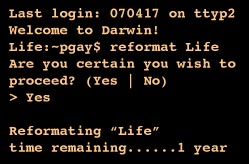 The end of another semester is upon us. As you may have noticed, this blog hasn’t exactly been updated for a few days. This was for a couple of different reasons. First and foremost, my day job as a professor at SIUE had me buried in test writing, grading, and searching my office for any potentially lost assignments. As of noon today, all that is safely behind me and grades are submitted. The second reason for the lull in blogging was my choice to spend some time coding. You may have noticed that some advertisements have sprouted up on the right side of the screen, and there are now links for donations in the sidebar. These website changes were not-so-subtle hints that with the end of the semester, this blog and podcasting are going to become my new day job for a while.
An academic life punctuated with bullets
Every university seeks to convince parents (and itself) that it is a safe place where learning and personal development are fostered in a protective yet stimulating environment. This is part of the myth of the Ivory Tower: we form the intellectual fortress where the knowledge-wealth of a society is stored, and intellectual returns roll in at double-digit rates as papers are published and student sponges absorb the words of the marble and bronze professors we’ve placed on pedestals.
In truth, universities are just places that strive to be more, but often struggle to make their dreams reality. As places run by humans and often open to the public, they aren’t as secure as we may desire. While the majority of crimes are related to random strangers entering campus to thieve, and peep, and sometime grope and rape, the most tragic crimes we see are the ones perpetrated by the students and staff who become broken as they try to run the academic gauntlet.
Dorrit Hoffleit, 1907-2007

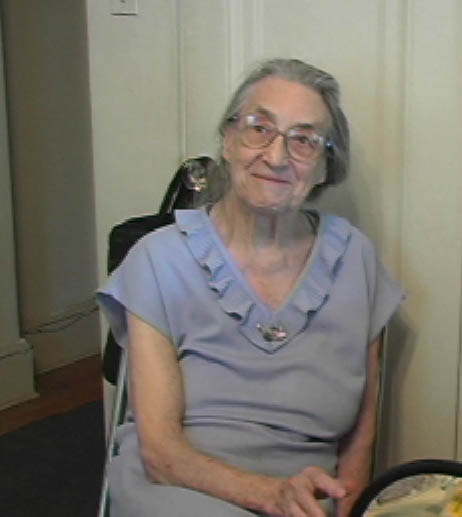 She turned 100 on March 12 and passed away after a breif illness on April 9. She was sharp and witty and active all the way to the end. Many people have written about her, but I think her personal words describe her the best: “I do it because I like it. … . [Astronomy], it’s my life.”
This video is from an interview done in July of 2006 and re-editted yesterday.
July 2006 Interview with E. Dorrit Hoffleit:
Conflicted by Light
 As an Astronomer, I am very pro-dark sky. As a person in favor of migrating birds, baby sea turtles, and general good health, I’m anti-light pollution. As a human who wants to see our planet’s environmental crash slow down and reverse, I’m in favor of energy conservation. Generally, these three sets of opinionated voices in my head work in tandem to encourage people to use down-pointed lights that contain orange-ish low-pressure sodium lamps. When those don’t work, I turn to the web site of the International Dark-Sky Association (IDA) where they list lighting, even Antique Street Lamps that would match my historic neighborhood’s idea of good landscaping. Unfortunately, a new light on the block is going to bring conflict to the normally collaborative voices. That new light is the ulta-luminous white LED. Taking 63 watts to produce 8500 lux, and lasting roughly 30 years, these brand new lights are every energy savers dream come true. Municipalities are considering switching to this new new tech toy to save city resources. Unfortunately, white LEDs (see image left, credit: CREE lighting) are every dark sky dreamer’s worst nightmare.
The Detritus of Travel
As a professional person, I have both the pain and pleasure of getting to travel semi-regularly. There are professional conferences to attend, public talks to be given, business meetings in far off cities, and sometimes there are just vacations to see friends and family. Tonight I’m getting ready to fly to Boston to attend a meeting at the AAVSO. As I’m packing, I’m going through all my bag’s pockets trying to find things to remove to lighten by load. Its amazing the things we travel with. My “never leave home with out” stash of dayquil and nightquil fills one pocket, and a stash of pens fills another. I keep finding the dead batteries I refused to throw out, and have carried home from hither and yon to recycle. There are business cards I’ve collected and flash drives and CDs littered with backups of talks and copies off presentations. As I empty my bag, I seem to be building the skeleton of a conference past as I prepare for a conference future. There is a lot that you can learn from the garbage of a person. My clutter of not-needed-now cables, connectors and cameras screams, “Watch out, this one just might record your image, your voice, your data,” while the scraps of paper portray a pack rat not quite organized enough to record everything in my digital address book.
The Sky *was* Falling
On Monday, March 26, a Chilean flight to New Zealand was almost struck by falling bits of space something. The pilot of the flight noted he could see burning up materials both in front and behind the flight. (Information obtained from numerous news sources). Some reports attributed the falling carnage to a Progress M-58 burning up through the atmosphere as it returned from the International Space Station, or at least insinuated as much. In fact, there had been an alert that such a re-entry would be occurring. According to US space officials, however, at the time of the incident the Progress was still attached to the ISS, and no set of calculations can make a Progress be in two places at once. The US Space Surveillance Network had no reports of other re-entering space junk. With all known space junk ruled out, it looks like that airplane was almost almost hit by an asteroid.
That silly little kid in me wishes I had been on that airplane. They could actually hear the fragments burning up.
Should I worry about meteors when I fly? Nope. And doing stats can be fun.
A Few Caveats regarding Day Length
I have to admit I have spring fever. I seem to have moved to a part of the country where the seasons actually follow the solstices and equinoxes, and politely divide themselves into 4 fairly equal parts. My crocuses are blooming, shorts are starting to appear on some of the more robust males on campus, the Canadian geese have paired off (which is actually very freaky), and tonight the Sun crosses the equinox at 7 minutes after midnight in Greenwich (that’s GMT-0). The Sun, when it rises over Edwardsville and campus tomorrow, will be hanging out over the Northern Hemisphere.
When I teach about equinoxes and solstices in class, the observant student may notice a slight discrepancies between what is taught and what they find in their newspaper. For instance, I’ll say that on the Equinox, the Sun rises exactly in the East and sets exactly in the West (totally true). I’ll say the Sun passes directly over the Equator at the Equinox (also, totally true). And, I’ll say the day and the night are equal on the Equinox (kinda sorta true). What I don’t do is define sunrise and sunset, and this is where that last “kinda sorta, huh?” moment comes into play.
Honesty in Observing:
The Crab Nebula & an 8.2-m telescope
 As I’ve mentioned before, press releases that don’t really contain science are one of my pet peeves. That said, one such press release came across my inbox this morning and made me giggle happily. The image was of the Crab Nebula (above left: credit: NAOJ); a nearby supernova remnant formed in 1054. The telescope in question was Subaru; an 8.2-m telescope in Hawaii operated by Japan’s National Institutes of Natural Science. Subaru isn’t a facility that buries reporters in press releases. This pretty picture was just press release #4 for 2007, and the other three were solid new results (as were all the non-instrument or education related releases of 2006). So why did this non-science press release from such a respectable press office make me giggle?
Here is a quote from Toru Yamada, one of the observing team’s members: “We just wanted to look at something beautiful.”
I love honestly.
Fun with Mnemonics
 In Astronomy we have two terrible patterns of words to try and remember. One is the order of the planets: Mercury, Venus, Earth, Mars, Jupiter, Saturn, Uranus, Neptune (image left, credit: NASA). The other is the spectral types of stars: O, B, A, F, G, K, M. For both these patterns we have unsatisfying mnemonics. This week I am assigning my students to please come up with a new one for spectral types (and they can submit them in the comments here as well as in their HW if they want to share).
As well as getting their ideas, I thought I’d ask what you, my often silent non-student readers, think are useful ways to remember the planets and stars. So, in the comments, give me a sentence to remember you and the stars and planets by!
In Search of Darkness
 Star light, star bright, first star I see tonight…First star? Hello? You’re supposed to come out now. Stars? Someone? Shine? Please?
While I was a graduate student at the University of Texas in Austin I watched the Ring Nebula (M57) disappear. When I first arrived in 1996, this former stellar atmosphere was clearly visible in binoculars from the roof of the building I worked in (RLM). In 2000 I could no longer see it, but some of my more owl-eyed students could see it faintly contrasting against the background glow of too many city lights. When I graduated in 2002, it was just gone. No pair of 10×50 binoculars was going to find it. According to the Greater Austin Chamber of Commerce the city grew from 846,227 people in 1990 to 1,452,529 people in 2005. With that growth came lights, and with those lights came star consuming light pollution. As the world population grows and becomes progressively more industrialized, our entire planet is losing its ability to see faint stars and galaxies in the night skies.