
Archive of Writings
Additional articles can be found on EVSN.tv.
Countdown to Solar Maximum: Coronal Mass Ejections
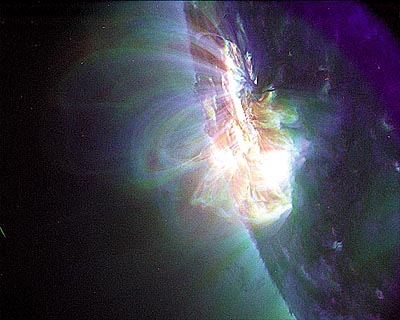 Anyone living in the extreme Northern or Southern latitudes has at one point or another looked up at night and seen the sky awash in color. Called the Aurora Borealis and Aurora Australis respectively, these natural-light shows are a by-product of material from the Sun hitting our atmosphere. Thinking back, high latitude denizens may remember some particular year when the aurorae were particularly amazing, and odds are that year was (give or take a year) some multiple of about 11 years before the year 2000; the year of the Sun’s last solar maxima. (For instance, some of you may remember solar storms between 1989 and 1991 that not only created dramatic aurora, but also caused several power failures in Canada and Sweden.) Our Sun has an 11 year sunspot cycle, and the maximum of this cycle also corresponds to a maxima in solar storms. These truly hazardous-to-electronics storms are dramatized in the new “The Universe” series as being a real threat to astronauts and satellites, and the hazards the show portrays aren’t unrealistic. As the Earth prepares to face the next solar maximum around 2011, we are also trying to find ways to predict hazards the Sun may be sending our way. (image credit: TRACE)
At the summer meeting of the AAS in Hawaii last week, one scientist presented one possible way we can know when we just might be in trouble.
Random Thought 3
Just watched the first episode of “The Universe.” It is accurate and so totally unlike anything I’ve seen on PBS that I’m at a loss for words. Take every cool image of the Sun you’ve ever seen, combine them with talking heads that are on sound stages instead of in university offices, and mix with high speed CGI animated content. Blend all on high for 45 minutes. This is not a bad thing, but it was not your Daddy’s science special. Clearly, this was science for the ADHD, digital generation – Not a single pause long enough to SMS “The Sun” was to be seen. With that audiance in mind, the only thing I could complain about is the lack of explaining what all the images of the Sun actually meant (okay, so that’s kind of big, however…). They somehow combined everything I address in 2 lectures on the Sun and its stellar evolution into 45 minutes, so I guess something had to get left out and everything else had to go fast. Zoom, Zoom, Zoom kind of fast. The History Channel is showing the episode over and over right now. Try catching it twice to catch the content, and then visit SOHO to find out what the solar images mean.
To Blog? To Sleep?
In this case, to sleep is the correct response.
Much blogging will be coming tomorrow and Monday.
For now I leave you with this thought: The Earth’s rotation combined with this time of year makes it such that if you take off in Maui at Sunset you land 4 hours later at LAX at Sunrise.
The Sun and its Danger Zone: The Chromosphere
One of the deeply confusing aspects of our Sun (and other stars) is their temperature structure. Starting in the core, the Sun is millions of degrees kelvin and supports nuclear burning. As you leave the nuclear burning core and climb first into the radiative zone and then the convective zone, the temperature systematically drops until it reaches a temperature of several 1000 degrees at a star’s surface. This makes sense. In the core, the gas is being compressed under the pressure of all the upper layers of the star gravitationally pushing down. The pressure allows nuclear reactions to release energy in a form that can heat things up: specifically light. That light then interacts with stellar material, being absorbed and reabsorbed over and over as it loses energy and goes on a random walk through the radiative region (think light bulb heating the air around it), and then (think of the lava lamp material above a light bulb) it also gives off energy as it heats cells of material at the base of the convective zone that rise and convectively give off heat as the cells rise (and then, when cool, sink back down).
So far so good.
The problem is, as you then move away from the surface of the Sun, you enter regions where the temperatures again go up – A lot – like back to millions of degrees hot levels of a lot!
And no one fully knows why. This is a very counter intuitive situation. Imagine that the surface of a lava lamp was 23C and the air half an inch away was 200C! In a press conference Wednesday, astronomers announced that they think they may have found a starting point for understanding what is going on in this bizarre situation.
Party at the AAS
 Tonight there will be a celebration of community building involving cocktails. To get details, just get Out of the Rain. (or look at the card at left)
Giving AAS a Face
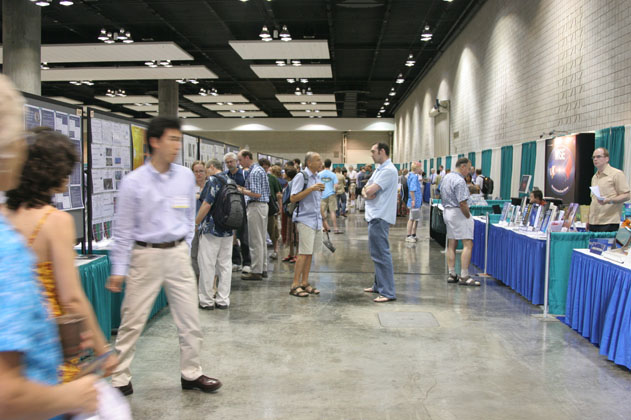 There is an excellant collection of photos from the conference (including one of yours truly) over at the 808scenezine.com that were taken by Katie Whitman. I’m still running around a bit madly, but I’ll be adding pictures to things. For now, get your photo fix here.
“The Universe” on TV
 A new player has emerged on the science special scene. The History Channel is premiering “The Universe” tonight. You can watch “The Universe” Tuesdays at 8pm/9c. The first episode is on “The Sun.” Here is what they plan to talk about:
All the news you’ll see again: Solar Atmospheric Heating, Tidal Tails, and Crab Nebula Explosion Date
Here’s highlights of the news I’ll be talking about later:
- Scientists have (again) found new tidal streams of material around the galaxy from a previously unknown, now shredded galaxy
- Scientists have (again) found a new explanation of how the Sun heats its chromosphere
- Scientists have (again) dated the Crab Nebula explosion to 1054 AD
New results, new press conferences and press releases, and, well, the same old same old. Science moves forward in incremental steps, and sometimes things circle and circle as they slowly move forward.
Black Holes and their Spin
There are two basic characteristics that describe black holes: Mass and Spin. Mass determines the size of the event horizon, the gravitational mass, and many of the ways the black hole can gravitationally shred people, planets and just about anything else. Spin is related to the magnetic field (which can also shred people because of the magnetic properties of water), and it exerts many relativistic effects on its surrounding, such as frame dragging. Black hole spin also allows the black hole’s associated accretion disk to extend closer in toward the event horizon, creating a (with future higher resolution telescopes) a directly imaginable effect.
In a trio of spin related press releases, scientists described how to measure spin, the consequences spin has on how black holes merge, and results on a test to check if our understanding is wrong.
All that’s sorta new in Exoplanets
Yesterday’s big afternoon press conference was all about exoplanets. The scientists took us on a tour de force of planet related press releases that went from little M stars and their tiny habitable zone, to a new press release on 28 planets, to planets found around sub-giant stars that were A-stars when they were on the main sequence. The catch was, while none of these stories had previously had related press releases, many of them (but not all) had related published papers or published pre-prints in the arXiv pre-print sever.