
Archive of Writings
Additional articles can be found on EVSN.tv.
AAS – Honolulu, Hawaii
I'll be there as a member of the press, and working with folks to organize the 2009 Year of Astronomy.
Random thought 2
 N.B. I’m going to post random thoughts on weekends. We all need to laugh, learn, and think in small amounts on weekends, and this is my small contribution
There are approximately 300,000,000 people in the U.S.
The U.S. is spending roughly $275 million* per day on the Iraqi war.

Celestron Nexstar 5″ Schmidt-Cassegrain GoTo scopes cost $799 plus shipping.
If the U.S. government spent on its people what it spends in Iraq in one day every person in America could own a nice GoTo telescope.
Random Note
When the freaky green star you are looking at through the apple tree suddenly darts left, you may be observing a lightening bug.
And it came from the CMB . . .
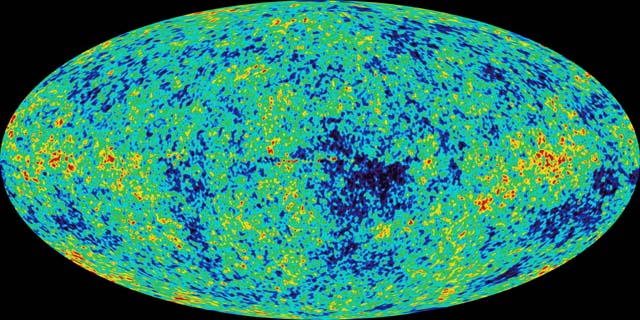 Fraser (my co-host over at Astronomy Cast) and I like to joke about how everything we know in astronomy we know because of the Cosmic Microwave Background. How do we know the universe formed during the Big Bang? The CMB. How do we know the cosmic geometry is flat? The CMB. How do we know the mass distribution of the Oort Cloud? The CMB. How do we know where babies come from? The CMB.
Okay, so that last one is an exaggeration. As far as I know, human babies and the CMB have nothing in common. The remark about the Oort Cloud, however, may not always be as far fetched as it sounds. A group of scientists working at the Harvard-Smithsonian Center for Astrophysics, and lead by David Babich, have theorized a new technique for determining the mass distribution in the Oort cloud using distortions in the Cosmic Microwave Background.
Dating Stars: HE 1523-0901
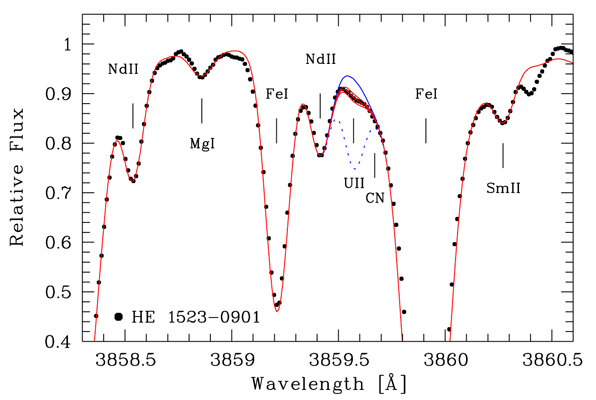 When trying to date a star, many websites state the problem is often best to approached with sweet words, lots of bling, and paparazzi repellent. A stint in the right rehab facility might increase your odds of success, and playing sports professionally has also worked for many individuals. To my mind, however, if you want to date a star, you need a good spectrograph, a multi-meter telescope, and a few clear dark nights. Any star worth dating can be had with this technique if the skies are right.
Seriously though, trying to determine the formation date of a stellar object is tricky business, and the best direct method we have involves studying the ratios of different nuclear isotopes in stellar atmospheres. Called nucleo-chronometry, this process first asks “In what ratio where all the elements in this star formed?”, and then looks to see in what ratios those elements are actually observed. In a perfect universe, there will be a baseline distribution of stable elements that appear in textbook perfect ratios side by side with unstable elements with long but varied half-lifes. It is this combination of different decay rates that allow the star’s age to be determined. For instance, if a star was expected to form with some amount A of element Fo* and some amount B of element Fi* (where Fo has a half life of 1 billion years, and Fi has a half life of 3 billion years), than after 3 billion years, we’d expect to see only only 1/2^3 A= 1/8 A of element Fo and 1/2 B of element Fi. Only one element is required to get a rough estimate of how old a star is – in fact carbon dating uses just the element Carbon-14 to measure the age of old organic materials – but more reliable results come from looking at more then one element.
This technique was recently used to identify a population III (extremely old, extremely metal poor) star in our galaxy as having an age of roughly 13.2 billion years. This star, named HE 1523-0901, is perhaps the oldest known star in our galaxy. At first glance, this is just another story of someone going, “Oh neat, an extreme,” but the reality is, determining the age of a star is a real bear, and, in many cases, it just isn’t possible. This piece of research, lead by A. Frebel of my graduate alma mata the University of Texas, and including T. Beers, my undergraduate advisor at M.S.U., required a lot of hard work, and 7.5 hours on the ESO’s Very Large Telescope in Chile.
All the news that tried to escape
Today’s American Astronomical Society news feed brought me a small handful of press releases. Three releases (1, 2, 3) all related to the approximate mapping of the exoplanet HD 189733b and the discovery that exoplanet HD149026b is the hottest known world. Cool. The forth and final press release I received was also planetary science related, and embargoed, so I can’t really tell you anything beyond that my news feed lead me to believe that astronomers are currently only studying planetary science. The truth is, astronomers are exploring all the heavens have to offer in voracious detail, but the press officers (and press in general) are neglecting a lot of cool science going on in other areas.
Flipping over to the arXiv e-print service, a different picture emerges. The couple dozen submitted works for Wednesday, May 9, spanned subjects from string theory to CMB Anisotropies and the outer Solar System (1, 2). Some papers are still in peer review, and others will never be submitted to journals. All the papers are sitting there waiting to be read and learned from, and hopefully someday cited by someone not on the author list.
The Big Bang and the Universe’s Big Future
From September 10-14, I'll be working with the Davidson Institute's Young Scholars program to put on an online colloquium titled, "The Big Bang and the Universe's Big Future." Abstract: Astronomers, on a CSI-style mission, have followed the clues to find the culprit...
Webcast for San Mateo AANC-Con
Details still being worked out. More to come! Check out the
An Amazing and Expanding Universe in Motion
From August 7-11, I’ll be working with the Davidson Institute’s Young Scholars program to put on an online colloquium titled, “An Amazing and Expanding Universe in Motion.”
Abstract: Looking for something entirely different? Take a tour through our ever changing universe that is (loosely) guided by Monty Python’s “The Galaxy” song. In this colloquium, students will explore the cosmic history of our planet, how we are evolving and revolving though space, and where we and our galaxy are headed in the future. Basic geometry and algebra will be used to understand the math a physics behind our planet’s position in time and space, and to understand why the numbers that apply to England don’t apply to Ecuador!
Not familiar with the song? Check out this rated [PG] google video.
Twilight on Earth,
Morning on Gleise 581c
 There are certain questions and dreams that drive society in its quest for the stars. Is there life beyond the Earth? How (and when) will we reach other worlds? What will it take to reach other worlds with life? For a long time, astronomers thought that we were still a long time away from being able to find the type of planets a person can actually stand on. Until within just the past couple weeks, we had assumed that it would take a new generation of space missions – Terrestrial Planet Finder, Darwin, some space-based interferometer – before discovery of these rocky worlds started entering the scientific literature.
But as soon as we think we know something, the universe has a habit of surprising us.
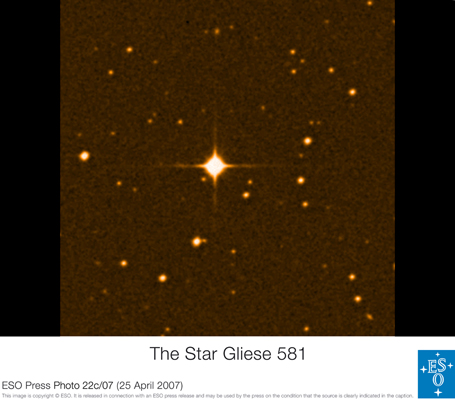
On April 25, the European Southern Observatory announced the discovery of a planet, Gliese 581c, with a mass M sin i* = 5 times the mass of the Earth. This is the smallest world that has thus far been found, and the first nearby world that we are fairly certain we can stand on (or at least sail a boat on). This little world is just 20.48 light years away. Using our fastest current space craft, New Horizons, and traveling at its zippy 10 mi/s, we could be there in just, um, well… 382,828.56 years.
Clearly faster space craft are called for.