
Archive of Writings
Additional articles can be found on EVSN.tv.
9th Carnival of Space
The 9th Carnival of Space is up at the Planetary Societ Weblog, which is written by Emily Lakdawalla.
All your words
I just want to drop you, my gentle readers, a message to say that yes, I do read all your comments. Sometimes (like this week), I get frustrated that I don’t have the time to respond to all of you. I want to write in response to all your emails, but doing everything is sometimes an impossible balancing act.
If you don’t read PhD Comics, at least check out their latest comic. For me it is currently a careful balance of writing this blog, Astronomy Cast, writing grants, doing research, answering email/comments, being married, and trying to keep up with our 110 year old house. Wheeeeee
Most days I love my life, but all days I feel like I’m behind in everything I want to do. There simply aren’t enough hours in the day. Sometimes, what I end up actually being behind in doing is writing answers to comments from you.
But I always read all your comments…
Gravitational Lenses: Making the invisible detectable
 Astronomers on Earth are limited in how they can look at the universe. We basically have three tools. We can detect light across a broad spectrum of colors. We can capture high energy particles – cosmic rays – that are flung at us from distant events. We can also potentially measure gravity waves (but we’re still sorting out that technology). In all three instances, we are limited by our technology’s sensitivity to an event. This means that faint, small, low energy stuff at any significant distance is invisible as far as our detectors are concerned. And stuff like dark matter… well… it can’t be directly detected at all. When direct detection of something is impossible, it becomes necessary to find indirect methods. We are like Plato, looking to understand reality but only able to see shadows dancing on a cave wall.
Two of the most well defined ways we have of studying the universe’s shadows are the Cosmic Microwave Background (CMB) and gravitational lenses. Both things are scientifically interesting in their own right, and each can be used to indirectly see otherwise invisible content in the universe. Recent papers have shown how the CMB may allow astronomers to study our own solar system’s Oort Cloud (the source of long period comets), and how gravitational lensing effects can be used to map dark matter. Rather than try and discuss both these topics in one post, I’m going to take on gravitational lenses today, and dig into the cosmic microwave background tomorrow. (image credit: Kneib & Ellis w/ Caltech Digital Media Center)
The Universe: Death, Destruction, and the Planet Jupiter
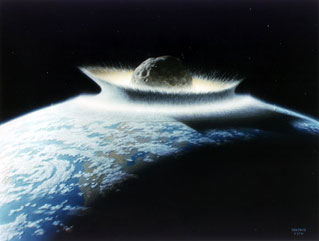 So, I have to admit to being a bit remiss in blogging about the Universe series. I have a reasonably good reason: I like my husband. That may sound like a non sequitur, but you need to understand that after dating a long series of science and engineering types who all thought astronomy was great, I decided I needed to date someone who recognized astronomy could be cool, but just wasn’t all that into it. This change in strategy worked, and the first non-science and engineering doing, astronomy non-loving person I dated I ended up marrying. He is totally into blues guitars, works as a software guru doing work that in no way overlaps anything I use computers to do, and we are very happy. Unfortunately, since he really doesn’t care about astronomy, he really has no interest in watching “The Universe” with me. Robot Chicken just keeps winning over science. (Image credit: Don Davis / NASA)
So, I had to find a few hours when we weren’t both watching the TV together to try and watch “The Universe.” I hate to admit it, but the first spare hour I found, I totally fell asleep watching the episode “The End of the Earth” after doing a day’s hard yard work. Yesterday, I finally got around to watching two episodes, the end of the Earth episode as well as “Jupiter: The Giant Planet.”
Watching the shows in quick succession I had three thoughts: 1) It is always risky to talk about current events in things that are getting produced on either a magazine or television time scale, 2) if you are working on a small budget you can go a long long way using graphics available in press releases and from astronomy education materials, and 3) if you want to sell a television show, life finding or life killing science may be the best direction to go.
Redshifted Formaldehyde
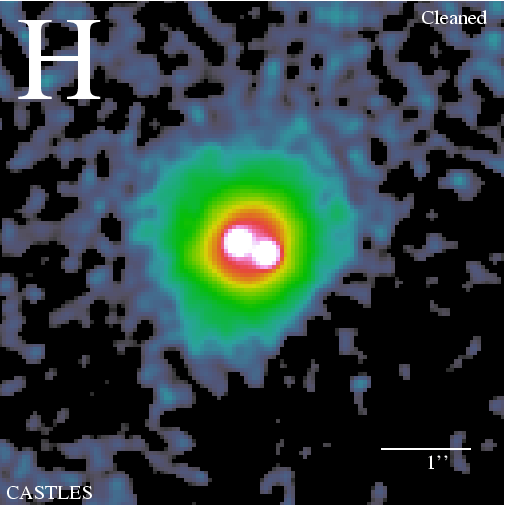 I just finished taking a tour through the latest papers posted on the astronomy preprint server. In general, few things do more to attract a my attention than a good title. One title in particular stopped my casual scrolling dead on its pixels: Redshifted formaldehyde from the gravitational lens B0218+357. Now, I knew beforehand that formaldehyde – the chemical people who store dead things used to use to preserve their specimens – existed in clouds of interstellar material. Other than knowing it is out there, I have to admit that I really don’t know why anyone cares that it exists beyond the “Oh neat” factor. So… I stopped to read the paper. (Image: CASTLES Survey)
Random Thought 5
I just looked over my podcast stats (a self hating act if there ever was one). My numbers have been slowly creeping up about 10 readers per week since I went daily at the beginning of May. It is sad, but it is encouraging. I see growth. It’s just slow. If you guys could plug my little blog whenever you see an entry that you like, I’d deeply appreciate it.
And tomorrow we return to our regularly scheduled onslaught on science.
Random Thought 4
Just last week, it seems, Venus was in Gemini and Saturn stood half a sky away in Leo. Seeing Venus and Saturn side-by-side in Leo the past couple days makes me wonder where the days have gone.
When you really watch the sky, it is truly amazing how fast things can move.
The Art of the Star Party
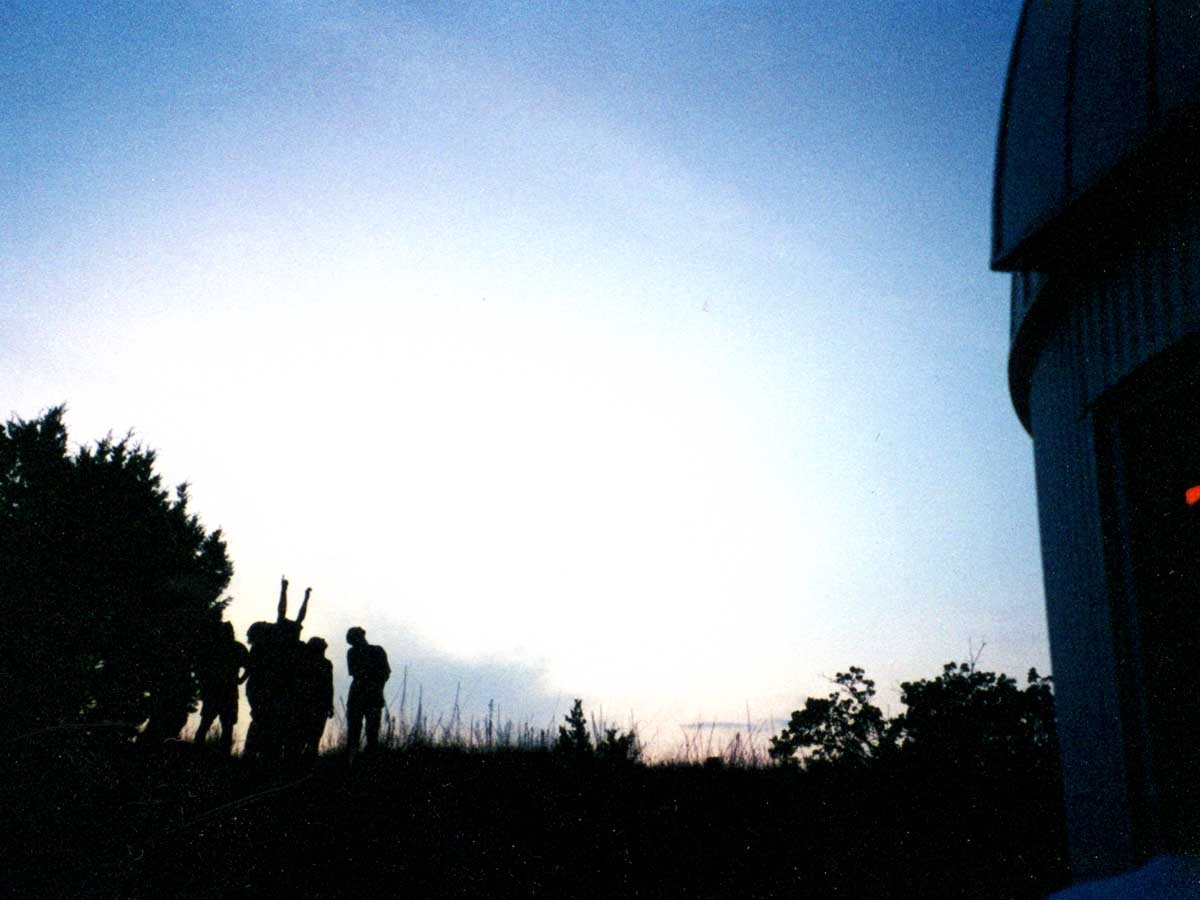 Last night I attempted to give a star party for a group of about 50 girl scouts. It was a noble effort, but I have to admit that it devolved into learned old(ish) person speaking before a group of seated in rows youngish people. I’m generally opposed to this type of teaching, but I had run out of plans.
Plan A: Lots of telescopes all pointed at different objects allowing people to go from scope to scope, and binoculars with volunteers so that people can get a hands-on-guided tour of the sky. However, since I had only 1 scope and 1 helper, this was not an option.
Plan B: Bring a bunch of star wheels and red-flash lights and teach everyone how to find their way around the sky, and then have one person man a scope while whoever else is available circulates answering questions and giving pointers. Unfortunately, since it was cloudy and we could see exactly 1 Moon, 2 planets and 9 stars, this too was not an option.
Plan C: Pamela (that would be me) hands out star wheels and red flash lights, teaches everyone how to use them, and then apologizes profusely for the weather. Pamela’s wonder assistant shows kids the Moon through the telescope. Pamela does tap dance involving “If you look here and pretend real hard, you might be able to see the big dipper and you can arc off the big dipper to Arctaurus, which is here, and if it was clear you could spike to Spica (which is hidden in this cloud).” This particular dance number was followed by a soft-shoe involving Saturn, a merengue on how to measure the distance to the Moon with lasers, and then a quick retreat.
Clearly, I need more plans.
Carnival & Happy Sun Crosses Northern Tropics Day
I hope you are all happily enjoying the first day of the Sun shining directly over Northern Hemisphere. If you are looking for a way to celebrate, let me suggest you take in the Carnival of Space over on my Astronomy Cast co-host Fraser Cain’s Universe Today.
You are the Center of the Universe (and so am I, and so is Gursplex on Alpha Eck)
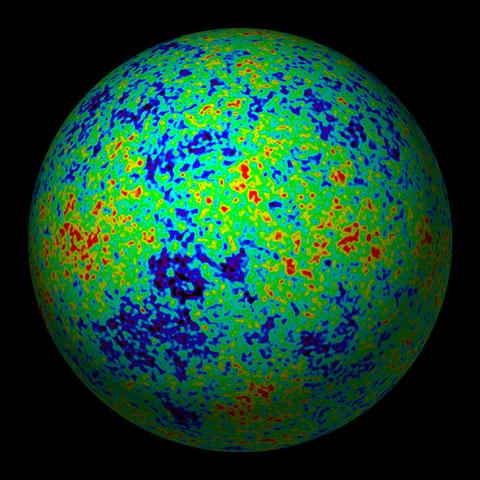 One of the concepts that confuses people most about the Universe is the Earth’s location relative to the Big Bang. People constantly ask, “Where is the center of the Universe?” and “Where was the Big Bang relative to us today?” and perhaps the most articulate of all, “Why does the Cosmic Microwave Background appear in all directions if it came from the Big Bang?” We are creatures accustomed to life in a three dimensional universe, and it is extraordinarily difficult to visualize our place in space. It is even harder to visualize that every place in space was once at the center of the Big Bang. (image credit: NASA/WMAP Science Team)